Why Men Are Giving Up in the AI Economy… And Why They Shouldn’t
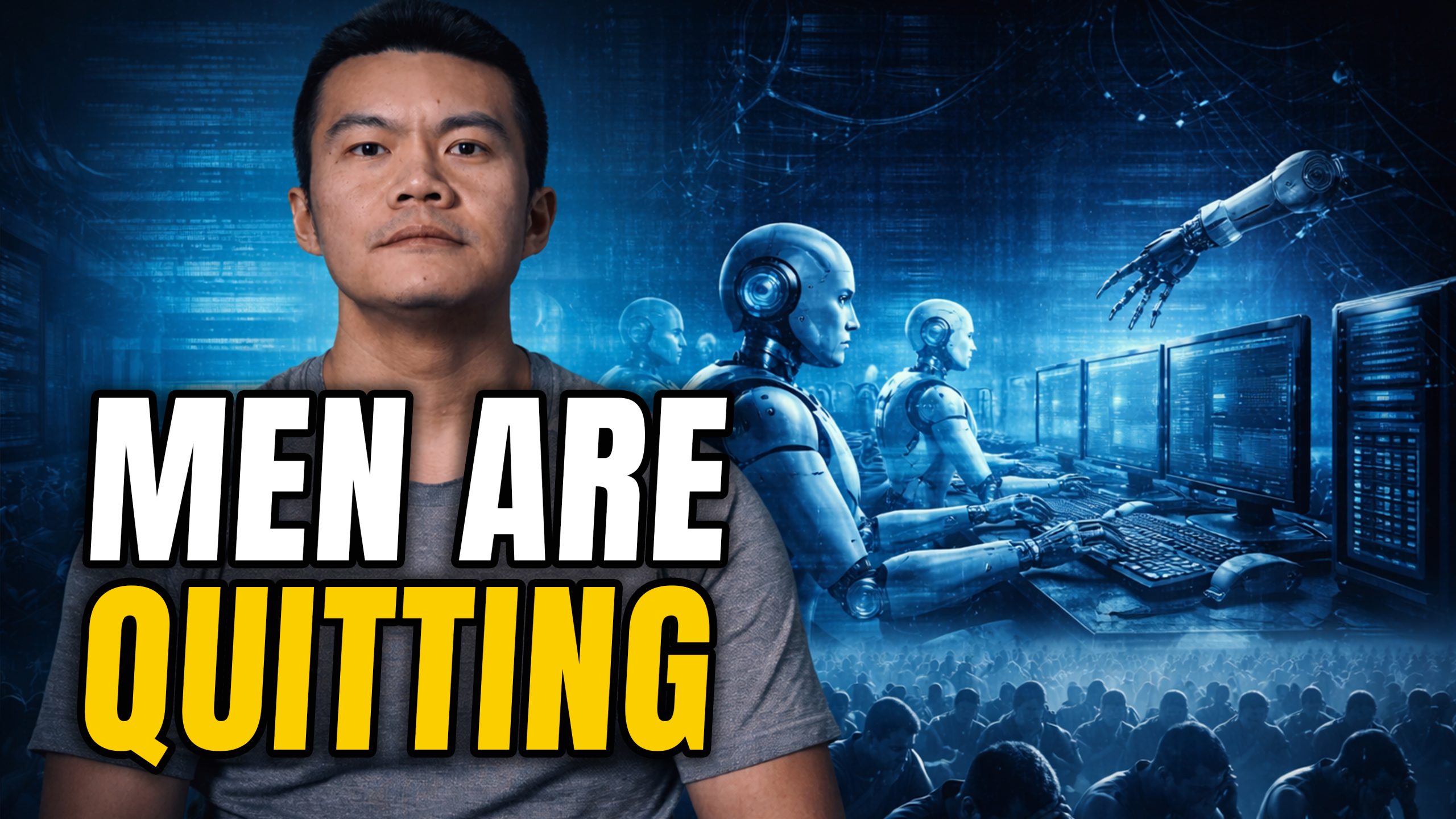
I’ve been seeing a lot of guys online saying there’s no point in building a family anymore. The economy’s bad. AI’s taking jobs. Divorce courts are stacked. And honestly… I get why it feels that way.
But here’s what I’ve been thinking lately…If men stop building, stop marrying, stop having kids…what exactly are we fighting for then?”
Fear can look rational. But sometimes it’s just fear.
Across social media right now, there is a growing narrative that trying to get a job in 2026 is a humiliation ritual. Young men are told they must send out thousands of applications, compete against algorithms, and watch corporations replace them with AI. They are told the economy is collapsing, that the middle class is dead, that robots will take over, and that marriage and fatherhood are irrational risks in an unstable world. The message underneath all of it is simple: the future is bleak, the system is rigged, and you would be foolish to build a family in a world like this.
It is understandable why that message resonates. Many Gen Z and millennial men feel disoriented. They have degrees but no clear path. They compete with automation. They see inflation rising and housing costs climbing. They watch friends struggle to find stable work. That anxiety is real. Christians should not mock it. But we must challenge the conclusion that flows from it.
The conclusion being pushed is this: because the economy is unstable and technology is advancing, you should delay or abandon marriage and children. Build only for yourself. Hedge your bets. Protect your assets. Avoid risk. Stay unattached.
That is not a Christian vision of manhood. It is a fear-based response to uncertainty.
Scripture has never promised economic ease. In fact, the Bible was written primarily to people living under political instability, persecution, poverty, and technological upheaval of their own eras. Yet the call was never retreat. It was faithfulness.
Jesus says in Matthew 6:33 (NLT), “Seek the Kingdom of God above all else, and live righteously, and he will give you everything you need.” Notice what He does not say. He does not say you will have a perfectly optimized labor market. He does not say you will never face automation or inflation. He says seek first the Kingdom. The promise is provision for what you need, not immunity from uncertainty.
Much of the modern despair about AI assumes that human worth is tied to productivity. If a machine can write code faster, diagnose disease faster, or process data faster, then humans become obsolete. That logic only works in a worldview where a person’s value equals their output.
Christianity rejects that premise entirely.
Genesis tells us that human beings are made in the image of God. Our value is not in our efficiency. It is not in our resume. It is not in whether we can outcompete a machine. A robot may calculate faster than you, but it cannot bear God’s image. It cannot love sacrificially. It cannot raise a child in the fear of the Lord. It cannot covenant with a spouse. It cannot disciple a soul.
When young men hear that AI will take 90 percent of desk jobs, they hear, “You are replaceable.” But the gospel says the opposite. You are uniquely called. Your vocation may change. The tools may change. The economy may change. But your purpose does not.
Another major fear expressed is that corporations do not care about employees. That may be true. Scripture never said they would. The Bible consistently tells us not to anchor our hope in systems or rulers. So if corporations are impersonal and governments are flawed, that is not a revelation that dismantles Christianity. It is confirmation of it.
The deeper issue beneath economic anxiety is this: many young men feel that without financial dominance, they cannot attract a wife or start a family. They assume they must reach a certain income threshold before they are worthy of marriage. When the path to wealth feels unstable, they delay commitment indefinitely.
Yet historically, families were not built on perfect economic security. They were built on covenant faithfulness and shared sacrifice. The idea that one must first eliminate all risk before marrying is a modern illusion. Risk has always existed. Wars existed. Plagues existed. Empires collapsed. Yet Christians still married. Christians still had children. Not because conditions were perfect, but because obedience and hope outweighed fear.
Psalm 127:3 (NLT) says, “Children are a gift from the Lord; they are a reward from him.” That verse does not contain a footnote about GDP growth or inflation rates. Children are not described as economic liabilities but as gifts. A culture that sees children primarily as financial burdens has already absorbed a materialistic framework. A Christian sees them through a covenant lens, not merely a cost-benefit analysis.
The argument is often made that the world is too unstable, too morally confused, too technologically overwhelming to bring children into it. But that logic would have prevented every generation of believers from reproducing. The Roman Empire was violent and morally chaotic. The early church still multiplied. Medieval Europe faced disease and famine. Christians still raised families. The twentieth century saw world wars and nuclear threats. Believers still chose life.
Hope is not naïveté. It is defiance.
When Christians have children, they are making a theological statement: God is not finished with this world. We are investing in a future we believe He holds. Every child raised in faith is an act of resistance against despair.
Regarding AI specifically, Christians should neither panic nor idolize it. Technology has disrupted labor markets before. The industrial revolution displaced artisans. The internet disrupted entire industries. Yet new forms of work emerged. Human creativity adapted. Christians, in particular, should remember that work is not merely employment. Work is participation in God’s creative order. Whether that is manual labor, caregiving, entrepreneurship, ministry, craftsmanship, or digital innovation, the essence of work is stewardship.
Colossians 3:23 (NLT) says, “Work willingly at whatever you do, as though you were working for the Lord rather than for people.” Notice the anchor is not the permanence of the job. It is the posture of the heart. Even if industries shift, the command remains. Work as unto the Lord. That means your dignity does not evaporate if a certain sector shrinks.
The doom-and-gloom narrative also tends to romanticize independence. The idea is that by avoiding marriage and children, you are freer to pivot, relocate, or protect assets. But Christian freedom is not isolation. It is self-giving love. Marriage is not primarily a financial arrangement; it is a covenant designed to reflect Christ and the church. Yes, divorce statistics exist. Yes, courts can be unjust. But fear of potential suffering is not a sufficient reason to reject obedience.
If anything, the instability of the modern economy should drive Christians deeper into community, not away from it. The early church in Acts shared resources. They supported one another. They did not face uncertainty alone. A Christian marriage rooted in shared faith, accountability, church involvement, and mutual submission to Scripture is not naïve optimism. It is covenantal realism. Two people seeking God together are more resilient than two individuals hedging their bets separately.
The claim that AI will create a permanent underclass and eliminate the middle class assumes that history moves in a straight, irreversible decline. Christianity teaches something different: history is under God’s sovereignty. Empires rise and fall. Technologies advance and become obsolete. Christ remains.
The young man tempted to despair needs to hear this: your future is not determined by algorithms. Your calling is not canceled by automation. Your masculinity is not measured by LinkedIn performance. You are called to cultivate, to protect, to provide, yes, but provision is ultimately from the Lord. You are a steward, not the source.
That does not mean passivity. Christians should develop skills. They should innovate. They should adapt. The biblical call to diligence is real. But diligence without hope becomes anxiety. Adaptation without faith becomes panic. We are not called to control the future. We are called to be faithful within it.
The narrative that says “It’s too risky to marry and have kids” is rooted in self-preservation. The Christian story says something radically different: “Whoever wants to save their life will lose it, but whoever loses their life for my sake will find it.” Marriage and parenthood are forms of self-giving. They refine you. They humble you. They stretch you. They expose selfishness. They require sacrifice. But they also form you into someone stronger, steadier, and more Christlike.
The world may frame having children in an unstable economy as irresponsible. A Christian can frame it as an act of trust. Not reckless trust, but covenantal trust. Trust that God is not surprised by inflation. Trust that He is not scrambling to catch up with AI. Trust that obedience is wiser than fear.
The better story is not denial of economic challenges. It is refusal to let those challenges dictate ultimate decisions about love, covenant, and legacy. It is choosing to build even when the market feels volatile. It is raising sons and daughters who are not trained to panic at headlines but to stand firm in faith.
AI may change industries. Economies may fluctuate. But Christ is the same yesterday, today, and forever. And as long as He reigns, hope is rational.
The humiliation ritual is not job searching. The real humiliation would be surrendering your calling because the world feels uncertain. Christians have always built in uncertain times. They have always loved in fragile seasons. They have always had children in imperfect worlds.
And they have always done so because they believe the future belongs not to algorithms or corporations, but to God.
And that’s the better story.